

A daily prayer habit means setting aside a few moments each day to connect with God through prayer. It is not about perfection but about consistency and intention. This simple spiritual practice brings inner peace, mental focus, and spiritual strength. Over time, daily prayer helps calm the heart, guide the mind, and build a deeper relationship with God.
Many people want to pray regularly but struggle to stay consistent. Busy schedules, stress, and daily distractions often pull us away from our prayer routine. If you have ever missed days or felt discouraged, you are not alone. The truth is, spiritual growth through prayer begins with small, honest steps and the decision to keep showing up.
In this guide, you will discover practical and real-life steps to build a consistent daily prayer routine that fits your lifestyle. These easy strategies will help you strengthen your faith, stay mindful, and experience deeper spiritual growth through daily prayer without pressure or guilt.
The Spiritual Importance of a Consistent Daily Prayer Habit

Think about the people in your life who matter most. Your spouse, your kids, your best friend. How did those relationships grow strong? Through consistent connection, right?
Prayer works the same way.
When you establish a daily prayer habit, you’re not just checking off a spiritual to-do list. You’re building a relationship with something greater than yourself. You’re creating space for peace in a chaotic world.
What Happens When Prayer Becomes Your Daily Anchor
Here’s what changes when you commit to consistency in prayer:
Your mind finds clarity. Those racing thoughts that keep you up at night? Prayer gives them somewhere to land. It’s like decluttering your mental space, one conversation with God at a time.
Stress loses its grip. Studies show that regular prayer reduces cortisol levels. Your body actually relaxes when you pray. It’s not just spiritual, it’s physical too.
You discover strength you didn’t know existed. On days when you feel empty, prayer refills your cup. The power of blessings flows into your life when you make room for them.
Your perspective shifts. Problems that seemed massive yesterday suddenly feel manageable. Not because they’ve changed, but because you have.
The Ripple Effect in Your Life
A morning prayer routine doesn’t just affect you. It changes how you show up for others.
You become more patient with your kids. More present with your partner. More compassionate with strangers. Your spiritual growth radiates outward, touching everyone around you.
And here’s the beautiful part: you don’t need to pray for hours. Even five minutes of genuine connection can transform your entire day.
Understanding Why We Struggle with Consistency in Prayer

Let’s talk about the elephant in the room.
Why is it so hard to pray regularly? If it’s so important, why do we skip it?
You’re not alone in this struggle. Even the most devoted people face these challenges. Understanding why helps us find solutions that actually work.
The Real Reasons We Skip Prayer
Our schedules are packed. Between work deadlines, family responsibilities, and trying to squeeze in some self-care, adding “one more thing” feels impossible. Morning comes, and suddenly you’re rushing to get out the door. Evening arrives, and you collapse into bed.
We don’t see immediate results. Let’s be real. Prayer isn’t like scrolling social media where you get instant dopamine hits. The benefits are deeper, quieter. Sometimes it takes weeks to notice the shift.
We feel unqualified. Maybe you think your prayers aren’t “good enough.” You don’t know the right words. You fumble through verses. So why bother?
Guilt creeps in. You miss one day, then two, then a week. Now you feel too guilty to start again. The gap between who you want to be and who you are feels too wide.
Distractions are everywhere. Your phone buzzes. Your mind wanders to your to-do list. The dog needs to go out. Overcoming prayer distractions feels like an uphill battle.
The Perfectionism Trap
Here’s a truth bomb: waiting for the perfect time to pray means you’ll never pray.
You don’t need the perfect morning. The perfect quiet house. The perfect mindset. You just need to start where you are, with what you have.
Your Brain on New Habits
Science tells us it takes about 66 days on average to form a new habit. Not 21 days like the old myth suggests. Almost ten weeks.
That means the first two months will feel awkward. You’ll forget. You’ll mess up. Your brain is literally rewiring itself to make this behavior automatic.
Be patient with yourself. Every single day you show up counts, even if it feels clumsy.
5 Practical Steps to Start Your Daily Prayer Journey
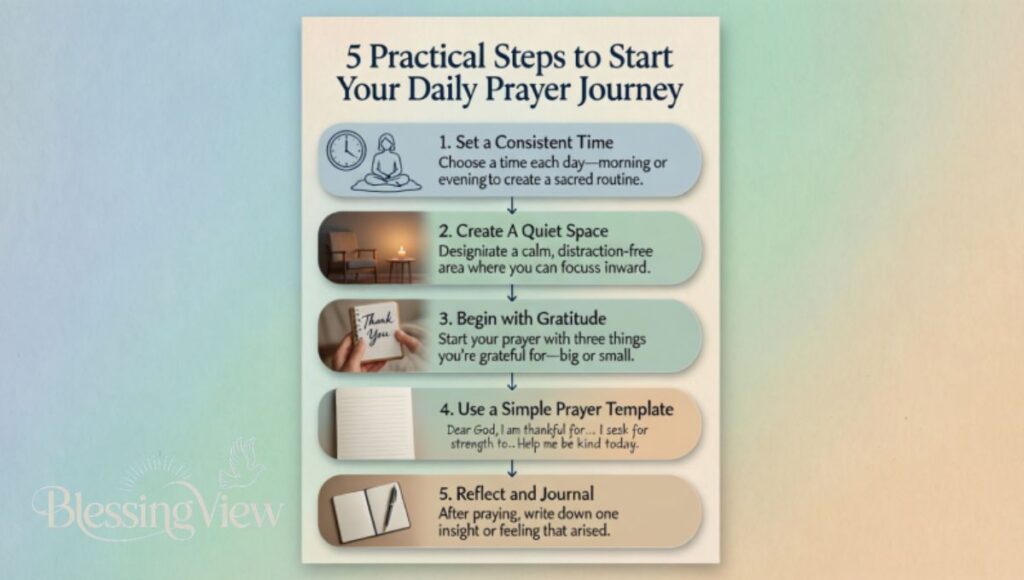
Okay, enough talk about why it’s hard. Let’s get into the how.
These five steps are designed for real life. For busy people. For those who’ve tried and “failed” before. For anyone who wants to build something sustainable.
Step 1: Start Ridiculously Small
Forget the hour-long prayer sessions you imagine spiritual masters doing.
Start with two minutes. Yes, two.
Set a timer if you need to. Sit quietly for 120 seconds and simply breathe. Talk to God like you’re talking to a friend. Share one thing you’re grateful for. Ask for help with one specific thing.
That’s it.
When two minutes feels natural (give it a week or two), bump it to five. Then ten. Small wins build confidence.
Step 2: Pick Your Sacred Time and Protect It
Consistency in prayer requires a consistent time slot. Your brain loves routines.
Morning people: Try a morning prayer routine right after you wake up. Before you check your phone. Before coffee, even. Those first moments of the day set the tone for everything else.
Night owls: Evening prayer works too. Right before bed, review your day. Express gratitude. Release worries.
In-betweeners: Maybe lunch break is your sweet spot. Or during your commute (if you’re not driving, obviously).
The key? Same time, every day. Your body will start anticipating it.
Step 3: Create a Simple Prayer Framework
Not knowing what to say paralyzes people. So create a simple structure you can follow.
Here’s one that works:
- Gratitude (30 seconds): Name three specific things you’re thankful for today
- Confession (30 seconds): Acknowledge where you fell short, ask for forgiveness
- Request (1 minute): Share your needs, worries, hopes
- Listening (1 minute): Sit in silence, be open to guidance
- Blessing (30 seconds): Pray for someone else
Total time: 3.5 minutes. Manageable, right?
As you grow, expand each section. But this framework always works, even on rushed days.
Step 4: Use Physical Anchors
Link your prayer habit to something you already do every day. Behavioral scientists call this “habit stacking.”
Examples:
- After pouring your coffee → pray
- After brushing your teeth → pray
- When you sit in your car → pray before driving
- After closing your laptop for the day → pray
Your existing habit becomes the trigger for your new one.
Step 5: Track Your Progress (Without Judgment)
Get a simple calendar or journal. Mark an X for each day you pray.
Don’t track how “good” the prayer was. Just that you showed up.
After a week, you’ll see a visual streak. After a month, you won’t want to break the chain. This taps into our natural motivation systems.
Miss a day? Don’t spiral. Just mark it and continue tomorrow. One missed day doesn’t erase your progress.
Creating a Prayer Sanctuary: Tips for a Distraction-Free Environment

Your environment shapes your habits more than you realize.
A cluttered, noisy space makes prayer feel impossible. But a peaceful corner? That invites you in.
You don’t need a fancy prayer room. Just a dedicated spot that signals to your brain: “This is where we connect with God.”
Designing Your Prayer Space
Choose your corner. It could be a chair by the window. A cushion in your bedroom. A spot on your couch. Consistency in the same place reinforces the habit.
Remove the obvious distractions. Put your phone in another room. Seriously. It’s the biggest prayer killer. If you use a prayer app, put your phone on airplane mode.
Add meaningful items. A candle you light only during prayer. A small plant. A photo that reminds you of blessings. Religious texts or journals. These create a sensory experience that your brain associates with prayer time.
Consider the lighting. Natural light is beautiful for morning prayers. Soft lamp light works for evenings. Harsh overhead lights? They don’t create a peaceful atmosphere.
Think about sound. Some people need silence. Others prefer gentle instrumental music or nature sounds. Experiment to find what helps you focus.
Overcoming Prayer Distractions When Life Gets Loud
Real talk: sometimes you can’t control your environment. Kids are home. Neighbors are loud. Construction outside.
Here’s what helps:
Noise-canceling headphones or earplugs. They create an instant bubble of quiet, even in chaos.
Earlier or later timing. If your house is a circus at 7 AM, try 5:30 AM or 10 PM instead.
The car sanctuary. Sit in your parked car for five minutes. Close the door. Instant quiet space.
Bathroom emergency. Not ideal, but sometimes locking the bathroom door for five minutes is your only option. God meets you there too.
Communicate boundaries. Tell your family: “I need five uninterrupted minutes each morning.” Most people respect clear requests.
Making Peace with Imperfection
Some days, your toddler will interrupt. Your dog will bark. The doorbell will ring.
That’s okay.
A distracted prayer still counts. The effort to show up despite obstacles? That deepens your spiritual growth more than perfect conditions ever could.
The Role of Gratitude and Blessings in Strengthening Your Habit

Here’s something powerful: Gratitude is the secret ingredient that makes your daily prayer habit sustainable.
Why? Because gratitude shifts prayer from feeling like an obligation to feeling like a gift.
Starting with Thanks Changes Everything
When you begin every prayer session by counting blessings, something happens in your brain chemistry. Literally.
Gratitude activates your brain’s reward center. It releases dopamine and serotonin, the feel-good chemicals. So prayer starts to feel good, which makes you want to come back tomorrow.
It’s a positive feedback loop.
The Three-Blessing Practice
Try this simple exercise for one week:
Every prayer session, name three specific blessings before you do anything else.
Not generic stuff like “I’m grateful for my family.” Get specific:
- Thank you for how my daughter laughed at breakfast today.
- Thank you to the stranger who held the door for me.
- Thank you for the warm shower this morning when I was cold.
Specificity trains your brain to notice blessings throughout the day. Suddenly, you’re collecting moments to share during prayer. You start looking forward to it.
How the Power of Blessings Creates Momentum
When you regularly acknowledge blessings, you become aware of patterns.
You notice that the provision shows up when you need it. That peace comes after you pray about anxiety. That relationships improve when you pray for difficult people.
These observations build faith. And faith makes consistency easier.
You pray not because you should, but because you’ve seen it work. Because you trust the process.
Gratitude as a Spiritual Anchor on Hard Days
We’ll talk more about spiritually low days soon, but here’s a preview: Gratitude is your lifeline when you feel empty.
On days when you can’t feel God’s presence, when prayers feel like they’re bouncing off the ceiling, gratitude grounds you.
You can always find one small thing to be thankful for. Clean water. A comfortable bed. The fact that you woke up today.
Start there. Sometimes that’s enough to reconnect.
How to Stay Consistent When You Feel Spiritually Low

Let’s address the toughest part of maintaining a daily prayer habit.
What do you do when you feel nothing? When prayer feels pointless? When God seems distant?
These valleys are normal. Every person of faith walks through them. The question isn’t if you’ll face them, but how you’ll respond when you do.
Recognizing Spiritual Dryness vs. Depression
First, an important distinction:
Spiritual dryness is a season where your faith feels flat but you’re generally okay. Depression is a mental health condition that affects everything.
If you’re experiencing persistent sadness, hopelessness, or loss of interest in things you normally enjoy, talk to a doctor or therapist. Prayer is powerful, but sometimes we also need professional help. There’s zero shame in that.
Show Up Anyway (This Is the Key)
The most important thing you can do during low seasons?
Pray anyway.
Not because you feel like it. Not because it feels productive. But because consistency in prayer during valleys builds character that serves you on mountaintops.
Think of it like this: you brush your teeth even when you don’t feel like it, right? Some days prayer is the same. It’s spiritual hygiene.
Adjust Your Expectations
During low seasons, release yourself from pressure to have profound prayer experiences.
Maybe your prayer is literally: “God, I’m here. I don’t know what to say. Help.”
That counts. Showing up is the victory.
Lower the bar for what qualifies as success. Spiritual growth isn’t always dramatic. Sometimes it’s just being faithful in the quiet, ordinary moments.
Lean on Structure When Emotion Fails
This is where your prayer framework saves you.
When you don’t feel inspired, fall back on structure:
- Read one Psalm out loud
- Recite a memorized prayer
- Follow your gratitude-confession-request-listening pattern mechanically
Motion creates emotion. Often, starting with structure leads to genuine connection, even when you thought it wouldn’t.
Connect with Community
Isolation makes spiritual dryness worse.
Tell one trusted friend you’re struggling. Ask them to check in with you about your prayer habit. Join a prayer group, even online.
Sometimes borrowing someone else’s faith for a season helps you push through until yours returns.
Remember This Is Temporary
Every spiritual low eventually lifts. Always.
The sun hasn’t disappeared just because you can’t see it through the clouds. Keep showing up. Your morning prayer routine might feel empty for weeks, then suddenly one day, the presence returns.
And when it does, you’ll be grateful you didn’t give up.
Celebrate the Discipline Itself
On days when prayer feels dry, celebrate the discipline.
You’re building character. Proving to yourself that you’re reliable. Creating neural pathways that will serve you for decades.
The spiritual growth happening during these times might not feel good, but it runs deep.
Bringing It All Together: Your 30-Day Challenge
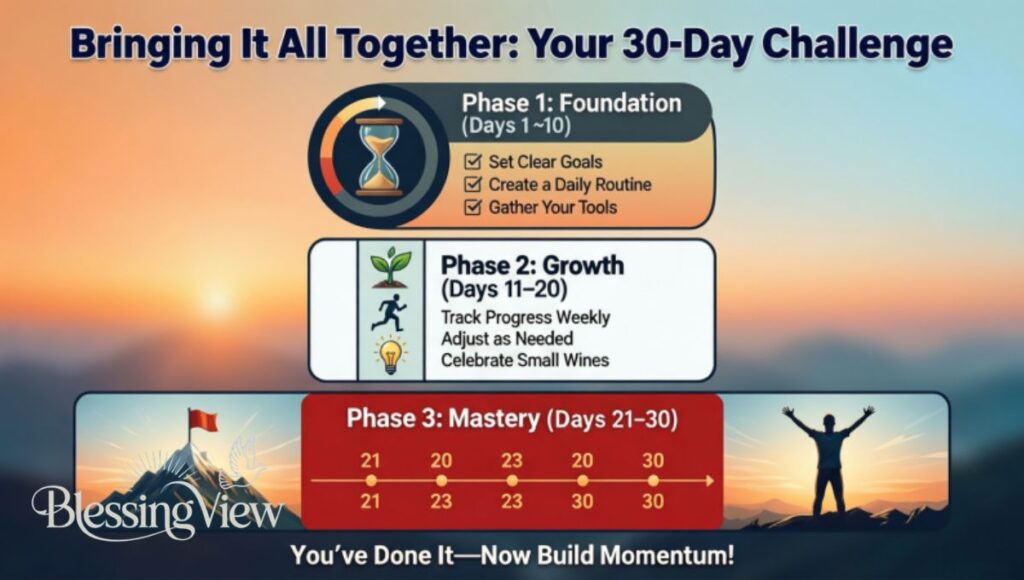
You’ve got the knowledge. You understand why consistency in prayer matters and how to build the habit practically.
Now it’s time to act.
Here’s my challenge to you: commit to 30 days. Just one month.
Your 30-Day Prayer Habit Blueprint:
Week 1: Establish the Baseline
- Choose your time and place
- Start with 2-3 minutes daily
- Use the simple framework (gratitude, confession, request, listening, blessing)
- Track daily with checkmarks
Week 2: Deepen the Practice
- Extend to 5 minutes
- Add one new element (journaling, reading scripture, etc.)
- Share with one person that you’re building this habit
- Notice how it affects your day
Week 3: Navigate Obstacles
- You’ll probably face challenges this week
- Apply the distraction-management strategies
- Adjust timing or location if needed
- Keep going even if you miss a day
Week 4: Create Sustainability
- Reflect on changes you’ve noticed
- Fine-tune your routine for long-term success
- Plan how you’ll continue past 30 days
- Celebrate your consistency
The Ripple Effect You’re Creating
As you build your daily prayer habit, you’re not just changing your own life; you’re also transforming the lives of those around you.
You’re becoming a different presence in your home. Your workplace. Your community.
People will notice something different about you, even if they can’t quite put their finger on it. Your peace. Your patience. Your perspective.
The power of blessings flowing through your life will overflow to others.
Frequently Asked Questions
What is a daily prayer habit?
A daily prayer habit is the practice of praying at a set time each day to connect with God, seek guidance, and find inner peace.
How can I start a daily prayer habit?
You can start by choosing a quiet time, setting a reminder, and beginning with short, sincere prayers each day.
Why is a daily prayer habit important?
A daily prayer habit strengthens faith, reduces stress, and helps you stay spiritually focused throughout the day.
What is the best time for a daily prayer habit?
The best time is when you can pray consistently, whether in the morning, evening, or before sleep.
How long should a daily prayer habit be?
It can be as short as 5 minutes; consistency matters more than the length of the prayer.
How do I stay consistent with a daily prayer habit?
Set a routine, remove distractions, and remind yourself of the spiritual benefits of daily prayer.
Can a daily prayer habit change my life?
Yes, regular prayer can bring peace, clarity, and positive changes in your thoughts and actions over time.
What should I pray for in a daily prayer habit?
You can pray for guidance, gratitude, strength, forgiveness, and the needs of yourself and others.
How do I build a daily prayer habit when life is busy?
Start small, pray at the same time each day, and treat prayer as an important daily appointment.
What are common mistakes in a daily prayer habit?
Common mistakes include aiming for perfection, skipping days without restarting, and being too hard on yourself.
Conclusion
Building a daily prayer habit is a simple but powerful way to bring peace into your life. It helps you stay connected to God and grow spiritually each day. Even a few minutes of prayer can calm your mind and strengthen your faith. What matters most is showing up with sincerity and trust.
With small, consistent steps, anyone can create a strong daily prayer routine. There is no need for perfection or long prayers to see spiritual growth. Stay patient, stay focused, and keep your intention clear. Over time, daily prayer will truly help in transforming your life.

Jack William Ki has 4 years of experience writing blogs on blessings and prayers. Passionate about inspiring others, he now contributes his insights and devotion to BlessingView.com, sharing positivity and spiritual guidance